
How to Choose an Arc Lighter Supplier: 7 Checks Before You Order
Most arc lighter sourcing problems start the same way. A buyer compares three or four suppliers on unit price, picks the cheapest credible quote, and places a trial order. Six weeks later the cartons arrive and something does not match the market: the charging port is micro-USB when every competitor has moved to USB-C, the safety switch is a slide that retail buyers call flimsy, or the packaging cannot carry a barcode without covering the warning text.
None of these are manufacturing defects. They are specification gaps that were never closed before the order was placed.
SKYTWO has been manufacturing small electrical products since 1991, and the arc lighter range is built on the same platform logic as our other lines. This guide covers the seven checks that separate a supplier you can build a product line with from one you will replace after the first container. It is written for importers, distributors and private-label brands, not for consumers.
Why Buyers Switch from Butane to Arc
An arc lighter produces a plasma arc between two electrodes instead of a flame, which removes fuel from the product entirely. That single change resets the commercial logic of the category.
A butane lighter produces a flame. It works in still air, costs very little per unit, and is the default product in most retail channels. It also runs out of fuel, fails in wind, and ships under flammable-goods rules.
An arc lighter has no fuel and no refilling. The customer buys once and recharges, so the value proposition is durability rather than consumable volume.
Four differences matter commercially:
| Butane lighter | Arc lighter | |
|---|---|---|
| Consumable revenue | Yes — fuel refills | No — recharge only |
| Wind performance | Poor | Strong |
| Cold weather | Reliable | Reduced battery performance |
| Transport | Flammable goods rules | Lithium battery rules |
The last row is the one buyers underestimate. A butane lighter and a lithium battery product travel under completely different transport regimes, and that difference changes your landed cost, your courier choice, and in some markets your ability to sell online at all.
Arc lighters sell best where the end user lights things repeatedly in uncontrolled conditions — outdoor cooking, camping, patio candles, workshop use. They sell less well as a straight substitute for a disposable lighter in a convenience store. Decide which market you are entering before you choose a supplier.
1. Ignition Type — Single Arc, Double Arc, or Flexible Neck
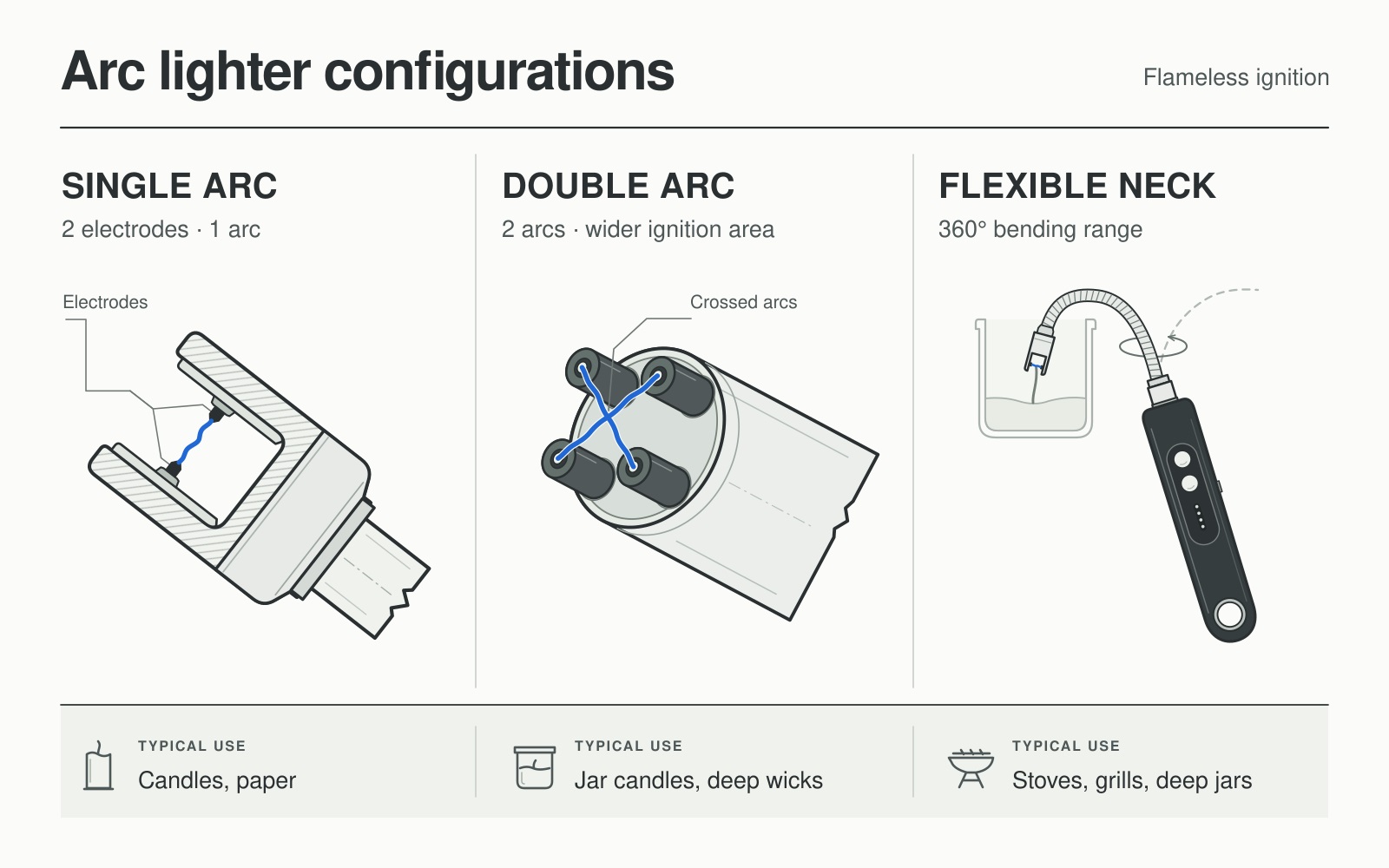
Ignition configuration decides what the product is good for, and “arc lighter” is not one product. Three configurations cover most of the market.
A single arc uses two electrodes and one arc. It lights candles and paper reliably and keeps cost down, which makes it the right choice for entry-level retail and promotional volumes.
A double arc places two arcs side by side, widening the ignition area so the user does not have to position the wick precisely. This matters for jar candles, where the wick sits deep and the user reaches in at an angle. Our TW-908 dual arc plasma lighter is built for this case.
A flexible neck moves the ignition point away from the hand. A long bendable neck reaches into a deep jar, a stove burner or a grill without tilting the body, which is what sells into home, aromatherapy and kitchen channels — see the TW-902 with its 360° neck and hanging hook or the TW-903 long-neck model with LED battery display.
Two checks before you commit. First, ask for the electrode gap in millimetres and whether the arc is continuous or pulsed; a wide gap with a weak driver produces a thin arc that fails in the field. Second, ask for video of the actual unit lighting a candle rather than a stock render, because “dual arc” is sometimes used to describe a single arc drawn across two visible electrodes.
One more point: single-arc units generally draw less current and run longer per charge. In a price-sensitive market with a simple use case, a single arc with a good driver beats a double arc with a cheap one.
2. Battery & Charging — USB-C Is Now the Baseline
The charging port dates a product faster than any other component. Micro-USB still appears in low-cost quotes and is increasingly a reason for returns and poor reviews, so treat USB-C as the default requirement rather than an upgrade.
Port type. USB-C is now expected in most Western retail channels. If a supplier’s standard tooling is still micro-USB, establish whether a USB-C version exists and what the tooling cost is. Do not accept “we can change it later” — the port is part of the housing.
Capacity and real-world use. Capacity is quoted in mAh and varies widely across the category. Our TW-908 uses a 230mAh cell; other models in the range differ. Ask what a full charge delivers in number of ignitions, not just milliamp-hours, and under what conditions that was measured.
Protection circuitry. This is the specification buyers rarely request and most often regret. Ask directly whether the board has over-charge, over-discharge and short-circuit protection. A lithium cell without over-discharge protection will be destroyed by a customer who leaves the unit in a drawer for a year and then finds it will not accept a charge. Confirm charging time and whether the unit can be used while charging, because safety and certification testing both depend on it.
3. Safety Lock and Child-Resistance
A safety mechanism is not a nice-to-have. It determines whether your product can be listed in certain channels at all.
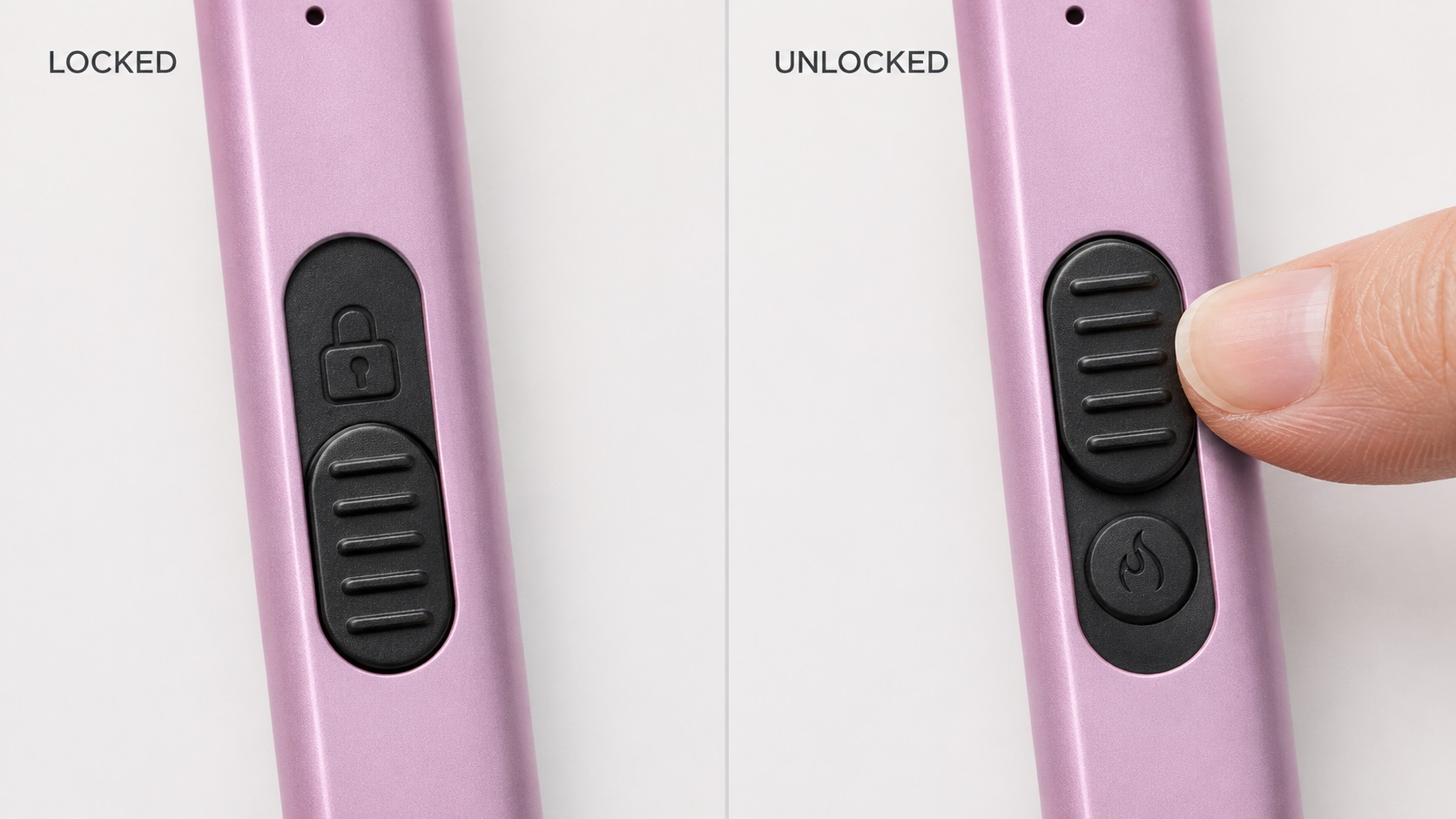
Three common designs. A slide switch is cheap but frequently criticised as too easy for a child to operate and prone to wearing loose. A press-and-hold button must be held during ignition: safer, but harder for users with limited hand strength. A mechanical safety pin or lock is a physical interlock released before ignition, which is the approach used in our TW-906 candle lighter with safety lock.
Which one you need depends on market and channel. Some markets restrict novelty-shaped lighters and impose child-resistance expectations, and the classification of an arc lighter under those rules is not always obvious — it can differ from a flame lighter. Confirm the position for your specific SKU with your importer of record before you print packaging.
Practical test: order a sample and try to ignite it one-handed while holding something else. If you cannot, your customers cannot either, and you will see it in the reviews.
4. Windproof Claims: How to Actually Test Them
Every arc lighter is described as windproof, and the claim is true only in a narrow sense: a plasma arc does not blow out the way a flame does.
A flame fails because moving air removes heat faster than combustion replaces it. An arc fails differently — wind cools the electrodes, and in strong gusts the arc becomes unstable or needs a second attempt. Read “windproof” as “does not extinguish”, not as “ignites first time in a gale”.
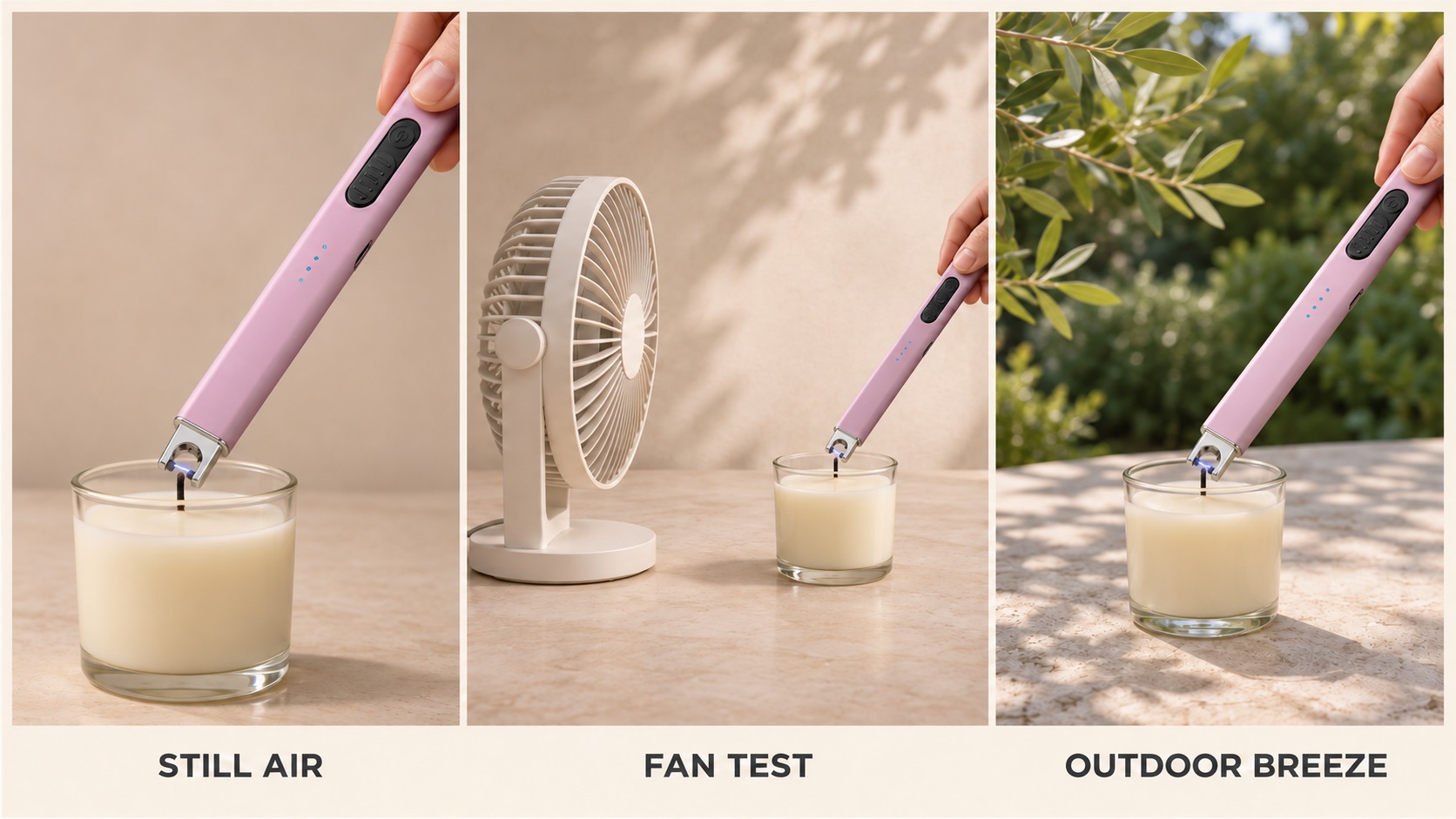
Test it in three steps:
- Still air — confirm the unit ignites on the first press, every time, from cold.
- Fan test — hold it about 30 cm from a household fan on medium and try to light a candle. Count the attempts.
- Outdoor test — take it outside on a breezy day. This is the condition your customer actually uses it in, and it is the test almost no buyer runs before ordering.
Ask the supplier what wind speed the claim is based on, and whether it was measured or estimated. A supplier who can answer has tested the product; one who cannot is repeating marketing copy.
5. Certifications to Ask For
Documentation is where experienced buyers and first-time importers diverge, and it is where a serious supplier will volunteer information before you ask.
EU Market Requirements
For an electrical product with a lithium cell, expect CE marking, an EU RoHS declaration, and the EMC test report behind the declaration of conformity — not the declaration alone.
Air Freight Documentation
Any lithium battery product shipped by air needs a UN38.3 test report and a safety data sheet (MSDS) for the cell. Without them your forwarder cannot book the cargo, and no amount of negotiation fixes that at the airport.
US Market: Confirm the Scope
Confirm with your importer of record whether the specific product form falls under consumer product safety rules for lighters. Do not assume that because an arc lighter has no flame it sits outside the scope; that assumption has cost importers real money in detentions.
Three habits that save money later:
- Ask for the test report by model number, not as a generic PDF. A report for a different SKU tells you nothing about the unit you are buying.
- Check that the report date is current and that the applicant name matches the factory you are dealing with.
- Keep the documents on file per shipment. Customs requests are retrospective and usually arrive months after delivery.
SKYTWO supplies test documentation according to the destination market. Tell us the market and the model and we will confirm which reports apply and what can be issued with the order — we would rather answer that question before your PO than after your container lands.
6. MOQ, Sampling and Lead Time
MOQ and lead time are driven by tooling and packaging, not by the number of units you want. Understanding which is which is what makes a supplier’s quote negotiable.
Sampling. Always sample before ordering, and expect to pay for it. A supplier who ships free samples of a battery product is usually recovering the cost somewhere else. What matters is whether the sample comes from current production or is hand-built for you — ask which. Our standard sampling time is 3 working days for existing configurations.
MOQ. Minimum order quantity depends on three things: whether the housing uses existing tooling, whether you need a custom colour, and how the product is packed. Existing tooling in a standard colour can start at 100 units. A custom Pantone colour means a minimum paint or injection run, and that number is not negotiable regardless of who you buy from — in our case, 3,000 units. Anyone quoting a custom colour below that is either absorbing a cost somewhere or planning to substitute a stock colour.
Lead time. Ask for it broken into components: production time, custom printing time, testing and packing. Our production lead time is 10 working days for standard configurations, and longer where custom colour or packaging is involved. A single “30 days” figure conceals which part is the bottleneck. For private label, packaging is usually the long pole, not the lighter itself.
Capacity. Ask what the factory can actually absorb. SKYTWO’s current capacity for this category is around 150,000 units per month, across a 20,000 m² facility. That matters less for a 3,000-unit order than for the question every buyer eventually asks: what happens when the product sells and you need five times as much by the same deadline.
Repeat order behaviour. Ask what changes on a repeat order. A supplier who re-tests every batch will tell you; one who ships from stock may not.
7. Private Label and Packaging
For most importers this is where the margin is actually made, and it deserves more attention than the lighter itself.
Logo application. Laser etching is permanent and works on metal bodies. Pad printing is cheaper and works on plastic but wears with handling. UV printing gives full colour on curved surfaces at a higher unit cost. Ask which method suits your housing material and request a physical sample of the logo, not a digital mock-up.
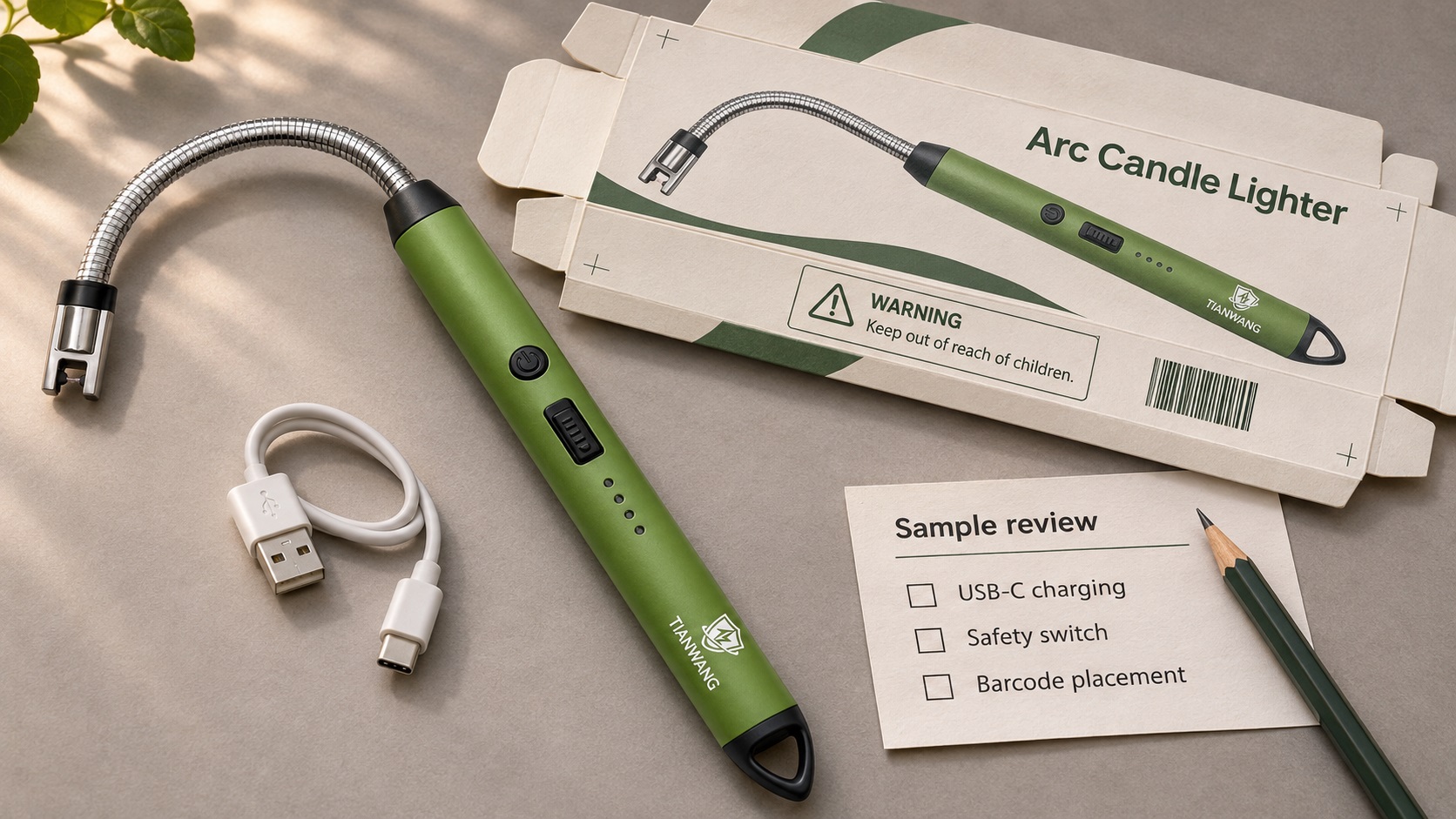
Retail packaging. If you sell into retail, the packaging carries the barcode, the warnings, the importer address and, in some markets, the battery disposal symbol. Get a dieline proof before production, because packaging errors are discovered after the goods are made.
Gift and multi-pack configurations. Sets sell well in gift channels — our TW-906 gift edition is the same platform positioned for that channel. If gift sets are part of your plan, raise it at quotation stage; retrofitting a gift box later usually means a new MOQ.
We run private-label programmes for buyers across Europe and North America, including a German outdoor equipment brand that orders in the tens of thousands of units a year. The pattern in those accounts is consistent: the first order is small and specification-heavy, and the volume follows once the packaging and documentation are settled.
Red Flags When Sourcing Arc Lighters
- Capacity or performance figures that do not reconcile. If a unit is quoted at a capacity that is physically implausible for its housing size, the number on the spec sheet is not the number in the product.
- No MSDS and no UN38.3 answer. A hard stop for air freight, and a sign the supplier has not shipped the product internationally.
- Only renders, no real photos or video. Ask for a photo of the unit with a handwritten note showing today’s date. It takes two minutes and tells you whether the product exists.
- A different model number on the test report than on the quotation.
- Willingness to print any claim you ask for without asking about your market. A supplier who never pushes back on compliance is not protecting you.
FAQ
Are arc lighters allowed on planes?
Lithium battery products are subject to air transport rules, and the applicable limits depend on the battery’s energy rating and how it is packed. Arc lighters are generally treated as battery products rather than flammable-gas lighters, but the specific allowance varies by airline and jurisdiction. Check with your carrier before shipping or advising customers.
Do arc lighters work in rain?
They will ignite in light rain, but water on the electrodes can interrupt the arc, and the housing is not necessarily waterproof unless stated. Do not market a standard model as waterproof without a confirmed ingress rating.
How many ignitions does one charge give?
It varies with capacity, arc configuration and ambient temperature. Ask for a measured figure rather than an estimate, and expect cold weather to reduce it.
What is the difference between “arc” and “plasma”?
In this category the terms describe the same electrical discharge. There is no separate plasma product; it is a marketing distinction.
Can you print our logo and pack in our own box?
Yes, subject to minimum quantities that depend on the logo method and the packaging format. Send your artwork and target quantity for a specific quotation.
Start Your OEM Inquiry
If you are building an arc lighter line for a specific market, the fastest path is to tell us three things: the destination country, the channel you sell through, and the ignition configuration you need. That is enough to narrow the range to two or three models and quote against real specifications rather than a generic price list.
Browse the full electric lighter range or send your requirement through our contact form. If you are still assessing the market, the catalog download lists the current model line-up with specifications, and our OEM and ODM services page explains what can be customised.